The Security Incident Is Closed. Who Decided the Underlying Pattern Is No Longer Relevant?
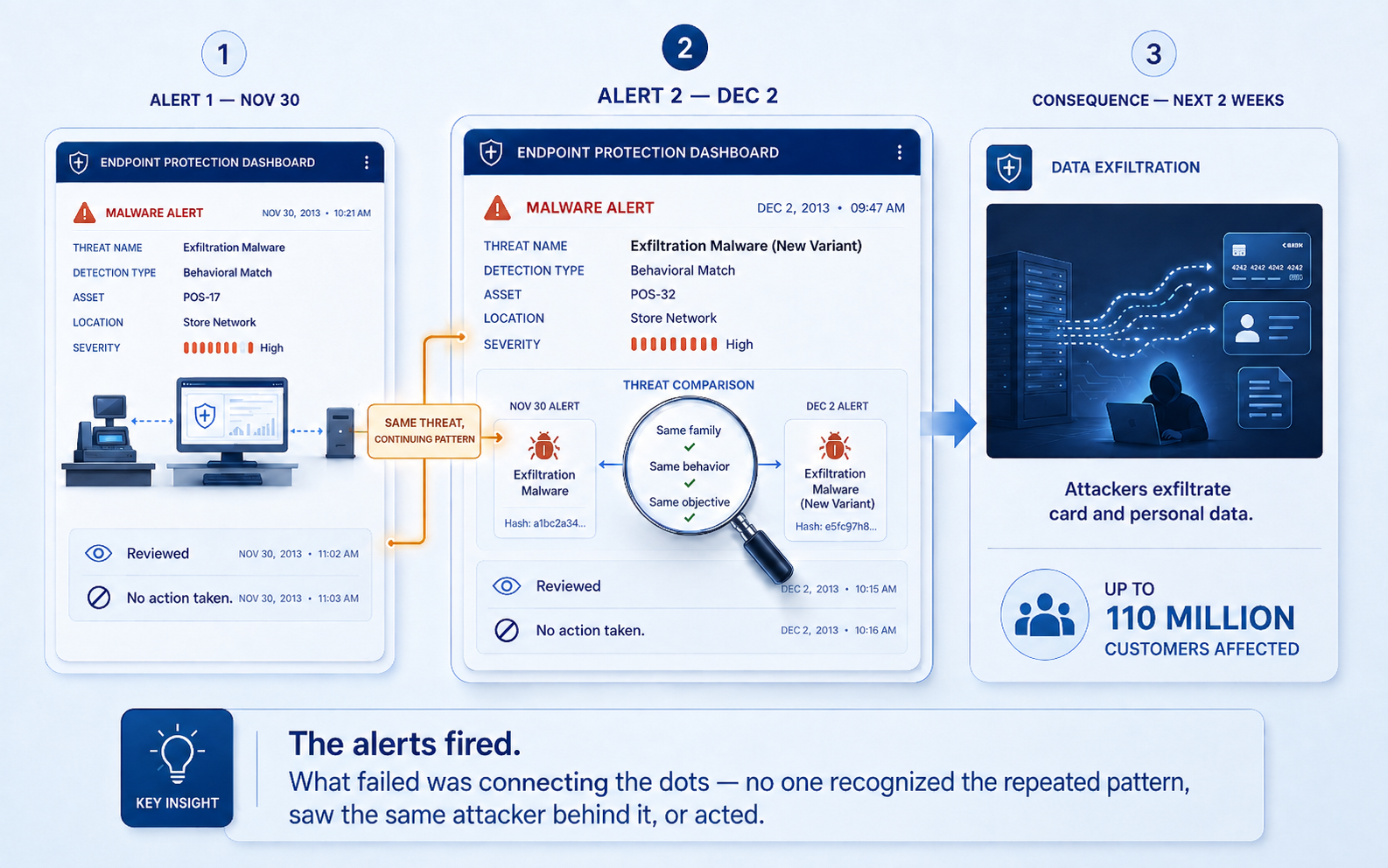
On November 30, 2013, Target’s malware detection software triggered an alert. Security staff reviewed it and did not act. On December 2, the same tool triggered another alert, this time flagging newly installed versions of the same exfiltration malware, right as the attackers began pulling stolen card data out of Target’s network. Security staff did not act on that one either. Over the following two weeks, the attackers removed the payment and personal information of as many as 110 million Target customers.
The tool worked. It flagged the threat, twice, days apart. What did not happen was anyone treating the second alert as a continuation of the first.
An Alert Is Not the Same Thing as an Incident, and an Incident Is Not the Same Thing as a Pattern
The U.S. Senate Commerce Committee’s staff report on the breach, “A Kill Chain Analysis of the 2013 Target Data Breach,” lays out the sequence in detail. Target’s FireEye intrusion detection system, monitored around the clock by a security team based in Bangalore that escalated findings to Target’s team in Minneapolis, sent an alert with the generic label “malware.binary” when the attackers first installed data exfiltration malware on November 30. Target’s Symantec antivirus software flagged malicious activity on the same server around November 28. When the attackers updated their malware and began exfiltrating data on December 2, FireEye alerted again. Target’s team did not act on either round of alerts, and did not enable FireEye’s automatic malware-deletion feature that might have removed the threat without requiring a human decision at all.1
None of this happened because the tooling failed. It happened because each alert was apparently evaluated on its own, as a discrete event to be triaged and dismissed or escalated, rather than as a data point to be checked against what a similar alert from three days earlier might mean when read together. A single generically-labeled malware alert, in a retail environment approaching its highest-volume shopping days of the year, plausibly looked like one more false positive in a very large queue. The same alert, considered alongside a nearly identical one from days prior on the same infrastructure, told a materially different story: an intrusion that was not a one-time event but an active, developing operation.
The Kill Chain Framework Exists Because This Failure Mode Is Structural, Not Incidental
The Senate report’s analytical framework — the intrusion kill chain — was originally developed by Lockheed Martin security researchers specifically because static, alert-by-alert defense was not sufficient against sophisticated intrusions. The kill chain model treats an attack as a sequence of stages: reconnaissance, delivery, installation, command and control, and exfiltration, and argues that a defender only needs to disrupt one stage to stop the whole chain. Applied to Target, the report identifies at least four separate points — the vendor credential compromise, the failure to isolate sensitive network segments, and the two rounds of ignored FireEye alerts — at which the company had information sufficient to intervene and did not.
That the industry needed to invent a named framework for this is itself informative. Kill chain analysis is not a tool that scans for malware. It is a discipline for asking whether today’s signal is connected to a signal from earlier in the sequence — something that most incident queues, built to close tickets rather than preserve relationships between them, do not do by default.
The Harder Question: Was This Negligence, or a Predictable Consequence of Volume?
It would be easy to read the Target case as a story of an unusually careless security team. That is not the full picture. Target had, according to testimony from its own CFO, layered defenses including firewalls, intrusion detection, and data loss prevention tools, and had been certified compliant with the Payment Card Industry Data Security Standard two months before the breach. The company was not operating without a security program. It was operating a security program during one of the highest-alert-volume periods of the retail calendar, evaluating a generically-named malware alert that, absent context connecting it to a related alert days earlier, was a reasonable candidate for a false positive.
This is worth taking seriously because the uncomfortable implication is that better intentions or more diligent staff would not, on their own, have solved the problem. What was missing was not vigilance. It was a mechanism for treating a dismissed alert as a piece of retained context rather than a closed matter, so that a second, related signal would be evaluated against the first rather than starting from zero. Alert fatigue and the difficulty of connecting related signals over time are now recognized as a distinct area of security research, reflected in academic venues such as ACM Computing Surveys publishing work specifically on the challenge.2
What Changes When a Closed Alert Stays Available as Context
The distinction worth building a security operations program around is between resolving an alert and discarding it. Most incident and case management workflows are built to do the former efficiently: an analyst reviews a signal, makes a disposition, and the queue moves on. Few are built to make that disposed alert easy to surface again automatically when a new, related signal appears on the same asset, from the same infrastructure, or matching the same behavioral pattern — regardless of how long ago the first one was closed.
Had Target’s environment treated the November 30 alert as a standing reference point rather than a closed ticket, the December 2 alert on the same server — involving an updated version of the same malware family — would have had a very different profile: not a fresh, ambiguous “malware.binary” notice, but the second occurrence of a threat already flagged once. That reframing does not require new detection technology. It requires an environment that keeps yesterday’s dismissed signal in view when tomorrow’s arrives.
Questions Worth Asking About Your Own Environment
- When an alert is closed as a false positive or low priority, is that decision retained anywhere an analyst would see it if a related signal appears later — or does the alert simply disappear from view?
- If the same asset or server generates two alerts three days apart, would your current workflow present them to an analyst as connected, or as two unrelated tickets requiring two independent judgment calls?
- During your highest-volume periods, does alert disposition speed increase at the expense of context-checking against recent related signals?
- Would your team be able to reconstruct, after the fact, which earlier alerts a confirmed incident was actually connected to — or does that reconstruction only happen once a breach is already public?
Closing a Ticket Is Not the Same as Closing the Question
The Target breach is not a story about a tool that failed to detect an intrusion. FireEye detected it twice, days apart, and named the specific malware behavior each time. It is a story about an operational structure in which each detection was evaluated as though it were the first and only piece of evidence, because nothing in the workflow was responsible for asking whether it was actually the second.
The right question for any incident review is not only whether the alert was correct. It is whether closing that ticket also closed the only place where the pattern it belonged to could have been seen.
U.S. Senate Committee on Commerce, Science, and Transportation, Majority Staff Report, “A ‘Kill Chain’ Analysis of the 2013 Target Data Breach,” March 26, 2014. commerce.senate.gov ↩︎
ACM Computing Surveys, “Alert Fatigue in Security Operations Centres: Research Challenges and Opportunities.” dl.acm.org ↩︎