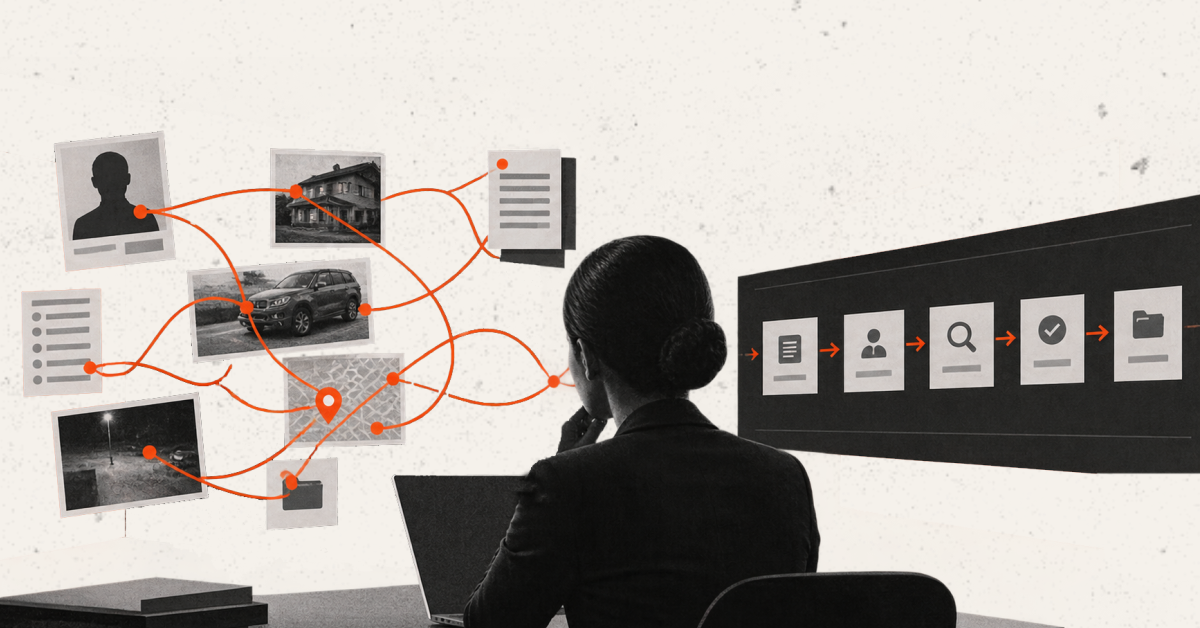
How Investigators Follow a Lead Back to an Earlier Question
Real investigative work does not move in a straight line. An investigator follows a lead, finds something that sends them back to an earlier question, and revises their view as new evidence comes in. A case workflow can show when a matter moved from intake to assignment, review and closure. For the colleague who inherits it, another part of the record matters just as much. What did the team check, what changed its thinking, and where did the evidence run out?
When one lead reopens another
Consider a hypothetical case. An investigator starts with a name. The name leads to an address. The address raises a question about a vehicle seen there. The vehicle appears in an incident logged in a different case months earlier, and that incident reopens a question about the original name. The path the investigator travels looks nothing like the sequence the case file anticipated.
At the next briefing, the investigator can summarize the result in a sentence. Reconstructing the path takes more work. Why did that address raise a question about the vehicle? Was it seen there twice, or did a witness mention it once? If those details survive only in a spreadsheet kept by the original investigator, the next person has to find the spreadsheet before deciding whether the earlier observation is reliable.
What cognitive research found about how analysts work
This is not a new observation. In a 2005 paper based on cognitive task analysis of intelligence analysts, Peter Pirolli and Stuart Card described analysis as two connected loops rather than a sequence. In the foraging loop, the analyst searches for information, filters it, and pulls out what matters. In the sensemaking loop, the analyst shapes that material into hypotheses and an account of what happened.1
The two loops feed each other. A developing hypothesis sends the analyst back to look for evidence that would confirm or undercut it. New evidence might strengthen the hypothesis, prompt a revision, or reveal a question the analyst had not considered. Pirolli and Card present a model of intelligence analysis and acknowledge variation in day-to-day work. Their account gives software buyers a useful test: how easily can an investigator return to a source after their understanding of the case changes?1
Consider an investigator checking whether a vehicle seen at a warehouse belongs to a person named in a report. A registration record identifies a different owner. That resolves the ownership question, but it leaves open who was driving. A clear case note preserves both findings. If another district later reports the same vehicle, a colleague can return to the driver question without repeating the registration check.
When structure keeps findings apart
The 9/11 Commission examined how pieces of information held by different agencies failed to reach the people who could use them. One of its examples concerned information that could have helped identify Nawaf al Hazmi in January 2000. Someone needed to ask the NSA for that information. No one did. A person who had no reason to know the information existed was in a poor position to request it.2
On page 417, the Commission discussed incentives that favored withholding information and recommended restoring a better balance between security and sharing. That observation concerned national intelligence agencies, their responsibilities and their access procedures. Its relevance to a case handoff is narrower: a colleague needs some way to discover an earlier finding before deciding whether to request the details.2
Are you modeling the work or the paperwork
This leads to a plain question for any investigative platform. Does it model the investigation, which loops and branches, or the report the investigation eventually produces, which is linear because reports are read from start to finish?
Try answering that question from the perspective of two readers. A supervisor wants to know whether the team completed the required reviews and who approved closure. An investigator reopening the matter wants to know why a particular lead went quiet. The same can answer both readers if the team preserves the observation, its source and the decision about what to do next. A disposition such as “review complete” answers only the supervisor’s first question.
Following the question through the record
An environment suited to how investigation works should let an investigator move from a person to a related address, vehicle, or prior case without leaving the workspace or losing the thread. It should keep branches rather than flattening them, so a line of inquiry set aside today can be picked up when it becomes relevant again. And it should treat connections across cases as a core capability, not a manual afterthought.
A case review often asks whether the required steps are complete. An investigative handoff poses a different question. If new evidence arrives, can the next person tell which possibilities remain open? In the warehouse example, the vehicle record gives the colleague an entry point. The registration source explains what the team established. The note about the unidentified driver tells them where further work might pay off.
That is a practical way to evaluate an investigative workspace. Start with a person, address or vehicle in a closed matter. Follow it into another case you are authorized to view. Can you see why the original team considered the connection relevant? Can you distinguish a verified relationship from a question someone intended to revisit? A link chart can show that two records share a vehicle. The underlying notes explain what the team knew about its use.
Hubstream’s investigative case management solution gives this approach a concrete form. Its user guide shows two investigations connected through a shared device. An investigator can open the link chart for the current investigation, see the device connected to the earlier investigation and follow that relationship into the records available to them. The same inquiry that began with a device can now return to a question about a person. The colleague taking over can inspect the earlier source and decide whether its finding applies here. The usefulness of the chart depends on what the team recorded about the link, including the distinction between owning a device and using it on a particular occasion.34
A practical handoff test
Take a recently closed case and ask the investigator to sketch the path they followed, including one return to an earlier question and one line of inquiry they set aside. Give the file to a colleague who did not work the case. Can that person find the evidence that prompted the change of direction? Can they tell whether the team ruled out the abandoned lead or simply lacked enough information to pursue it? A gap in one file gives you a specific place to improve the handoff.