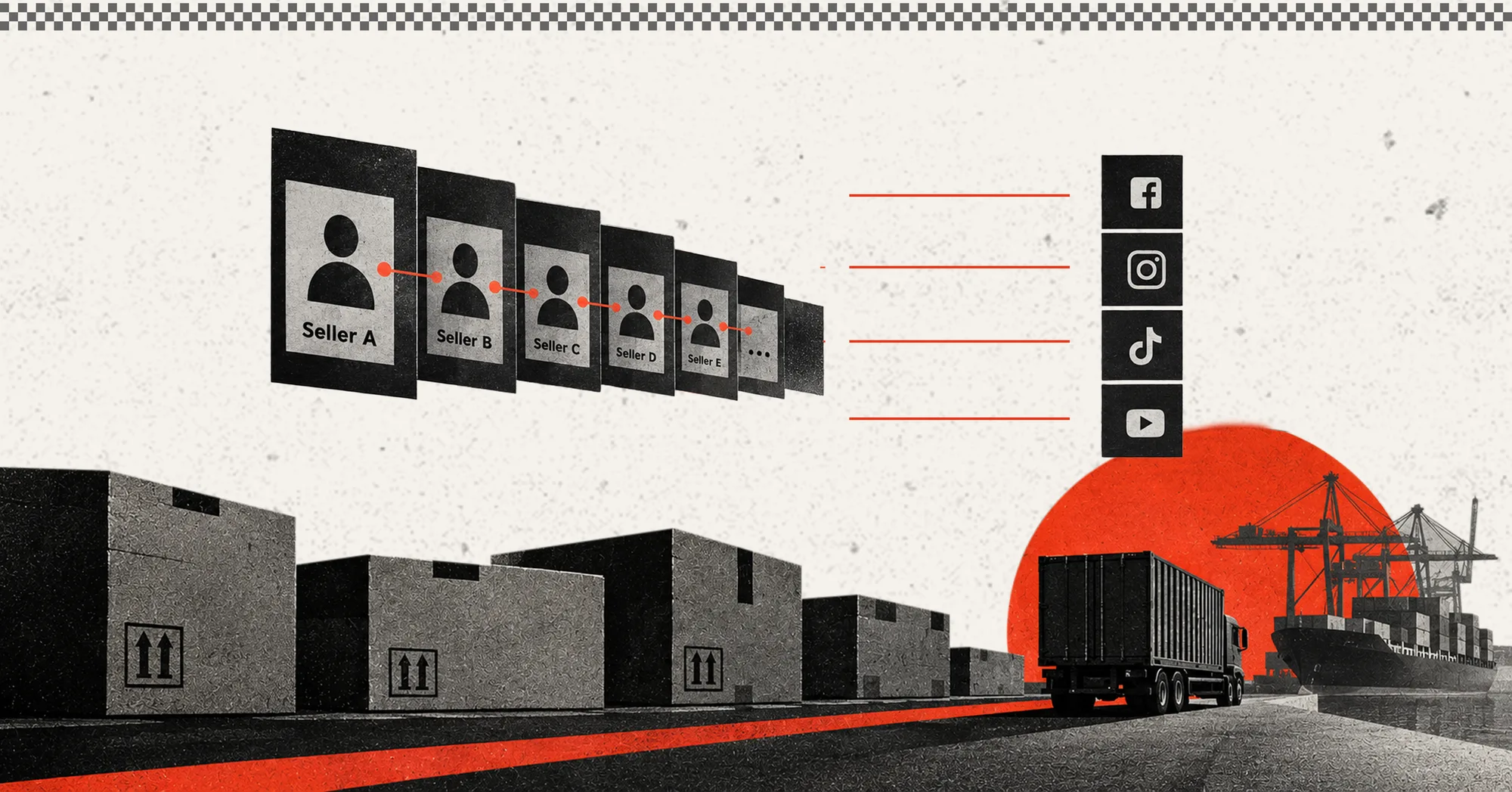
When Seller Names Keep Changing, What Actually Creates Investigative Continuity Across Counterfeit Cases?
A brand protection team gets a cease-and-desist letter signed. Border authorities seize a shipment and the importer signs a relinquishment. A lawsuit is personally served. By any normal measure, the matter should be over. Instead, the same operation keeps importing counterfeit goods under new names, rerouting deliveries to different addresses the moment a shipment clears customs, and selling through a rotating cast of social media accounts. Every one of those legal steps worked exactly as designed. None of them stopped anything, because the process was built around a name, and the name kept changing.
This is not a hypothetical. It is what the Federal Court of Canada found happened in Burberry Limited and Chanel Limited v. Ward, and the court’s response to it is worth examining closely, because it reveals exactly what “continuity” has to mean when a counterfeit operation treats its own identity as disposable.
Legal and Investigative Process Are Both Built Around a Name That the Operation Does Not Intend to Keep
Standard enforcement remedies, whether a platform takedown, a cease-and-desist letter, or a court injunction, are typically directed at a named party or a specific shipment. That is not a design flaw. It reflects due process: a court cannot restrain someone who is not before it, and a customs agency cannot detain a shipment it has not identified. The problem is what happens when the party being restrained treats the name attached to the restraint as the only thing that needs to change.
In the Ward case, according to the Federal Court’s judgment, Juvilyn Ward and Kevin Ward imported, offered for sale, and sold counterfeit Burberry and Chanel goods from a residential address in Edmonton over more than two years, from April 2021 through at least July 2023. Canada Border Services Agency detained an early shipment, and the defendants signed a relinquishment. Burberry’s counsel sent a cease-and-desist letter. None of it changed the underlying operation. The defendants continued importing goods under their own names and multiple fake ones, rerouting deliveries to alternative names and addresses specifically after shipments cleared customs, and sold merchandise through constantly changing Facebook accounts and livestreams distributed across numerous third-party pages.12
The Court’s Response Was to Make the Fact Pattern Portable, Not the Name
When Burberry and Chanel obtained default judgment after the defendants failed to participate in the case, Justice Walker did not simply grant a standard injunction against Juvilyn Ward and Kevin Ward by name. The court granted three additional remedies specifically tailored to an operation built on constant renaming. First, it ordered the defendants to disclose the names and contact information of their manufacturers and suppliers. Second, it ordered third parties, including shippers, who had notice of the judgment to disclose information about the defendants’ ongoing activity whenever the plaintiffs could show a bona fide belief that a shipment was connected to the defendants, whatever name it traveled under. Third, and most significantly, the court granted rolling injunctive relief: new aliases and shipments linked to the defendants could be added to the enforcement order through an informal motion, without requiring a new signed relinquishment or a new court proceeding each time a new name surfaced.
The mechanism is worth naming precisely. The court did not solve the renaming problem by identifying every alias in advance. It built a standing process for treating a newly discovered alias as a continuation of an already-established fact pattern, rather than starting the legal clock over from zero every time a name changed. Total damages awarded came to $395,000 for Burberry and $394,000 for Chanel in trademark damages, plus $120,000 in statutory copyright damages and $100,000 in punitive damages, reflecting what the court called the considerable reach of the defendants’ evasive conduct.
This Is Not an Isolated Ruling
The same evasion tactic, and the same judicial response to it, has continued to appear in Canadian Federal Court decisions since. In Louis Vuitton Malletier S.A. v. Torf, decided in 2024, the court found that even after an Anton Piller order and injunction were in place against one defendant, that defendant continued advertising counterfeit Louis Vuitton merchandise through a new Instagram account and sold a counterfeit bag to an investigator in early 2024, under the new account name.3 The pattern in Ward was not a one-time anomaly. It is a recurring feature of how these operations behave once conventional enforcement has already reached them once.
The Harder Question: Does a Rolling Order Solve the Problem, or Just Lower the Cost of Solving It Repeatedly?
It would be a mistake to read the Ward decision as having closed the gap entirely. The rolling injunction does not identify new aliases on its own. It still requires the rights holder to establish, each time, a bona fide belief that a new name or shipment is connected to the defendants already under judgment. What the order changes is what happens after that belief is established: instead of starting a new lawsuit or seeking a fresh court order, the rights holder can bring an informal motion. The court solved the procedural cost of continuity. It did not solve the evidentiary cost of continuity, which still depends entirely on the rights holder’s own ability to recognize that alias number twelve is the same actor as alias number one.
That distinction matters because it is exactly where most brand protection programs are weakest. Legal remedies, even innovative ones, only activate once an investigator has already made the connection. If nothing in a brand protection program’s daily workflow is responsible for noticing that a new seller account reuses a supplier relationship, a shipping pattern, or a livestream audience from a name already under enforcement, the rolling injunction has nothing to attach to.
What Actually Creates Continuity
Two different things get called “continuity” here, and they are not the same. Process continuity is what a court can grant: a standing legal mechanism that avoids restarting litigation every time a name changes. Evidentiary continuity is something no court order can create on its own: an ongoing, working record of the operational details, supplier identity, shipping pattern, imagery, payment rails, social account behavior, that persist even when the name on the account does not. A rights holder with strong process continuity but weak evidentiary continuity still has to rediscover the connection between alias twelve and alias one from scratch every time, informal motion or not.
This is the layer that sits upstream of the courtroom. An investigative environment that keeps a prior enforcement target’s operational signature available and actively checks new activity against it does the work that has to happen before a rolling injunction, or any other remedy, can be invoked at all. Hubstream’s approach to brand protection investigations is built around exactly that gap: preserving the operational detail behind a name, not just the name itself, so that when a new alias surfaces, the connection to prior enforcement is something the environment can already show, rather than something an investigator has to rebuild.
Questions Worth Asking About Your Own Program
- When a previously-actioned seller resurfaces under a new name, does your team recognize the connection because the environment surfaced shared details, or because someone happened to remember?
- Do you retain supplier, shipping, and payment details from closed enforcement actions in a form that can be checked against new activity, or does that information age out once a case is closed?
- If you needed to establish, today, a bona fide belief that a new account is connected to a defendant already under a court order, how long would that take, and what would you have to reconstruct from scratch?
- Does your enforcement program depend on identifying every alias in advance, or is it built to recognize a new one quickly once it appears?
The Name Was Never the Point
Ward, Torf, and the operations they represent treated their own names as the cheapest thing to discard. The Federal Court’s innovation was to stop treating the name as the anchor of the legal process and start treating the underlying conduct as the anchor instead. Brand protection programs face the identical choice, at a much earlier and more frequent stage than any courtroom. The question worth asking after every takedown is not whether the name was correctly identified. It is whether anything in the program would recognize that name’s replacement.
Cassels Brock & Blackwell LLP, “Whack-a-mole No More? Federal Court Grants Rolling Order and Third-party Disclosure to Combat the Sale of Counterfeit Goods,” January 15, 2024, summarizing Burberry Limited and Chanel Limited, et al v. Ward et al, 2023 FC 1257 (Federal Court of Canada). https://cassels.com/insights/whack-a-mole-no-more-federal-court-grants-rolling-order-and-third-party-disclosure-to-combat-the-sale-of-counterfeit-goods/ ↩︎
Federal Court of Canada, Burberry Limited and Chanel Limited, et al v. Ward et al, 2023 FC 1257. https://decisions.fct-cf.gc.ca/fc-cf/decisions/en/item/524139/index.do ↩︎
Louis Vuitton Malletier S.A. v. Torf, 2024 FC 1152 (Federal Court of Canada), CanLII. https://www.canlii.org/en/ca/fct/doc/2024/2024fc1152/2024fc1152.html ↩︎