If the Most Important Connection Sits Outside the Case, Why Is the Case Still the Center of Investigation Technology?
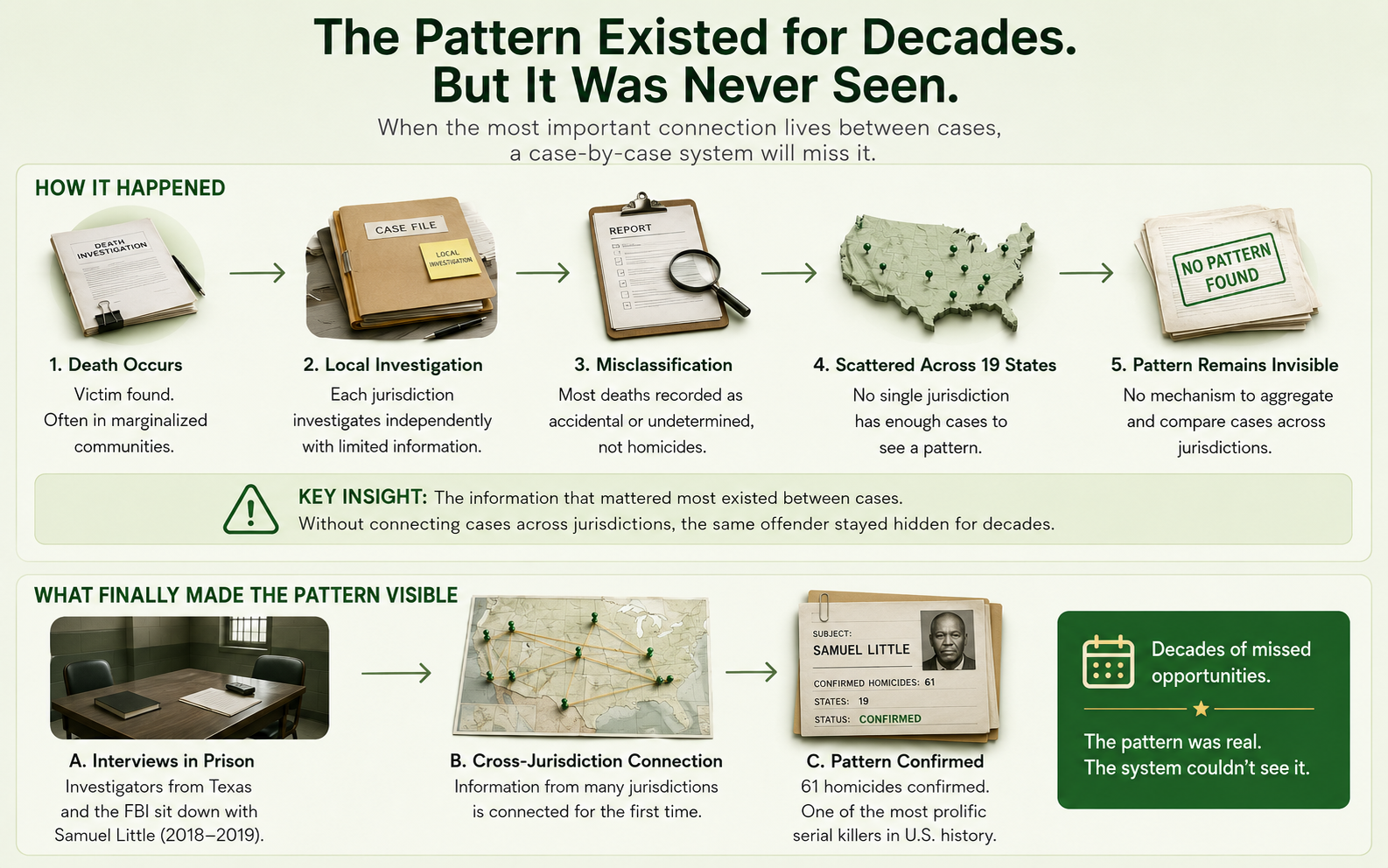
Samuel Little was 78 years old, incarcerated in California on an unrelated drug charge, when investigators from Texas and the FBI began sitting down with him in 2018 and 2019. He confessed to 90 killings across 19 states spanning four decades, from 1970 to 2005. The FBI has since confirmed 61 of those homicides, calling him the most prolific serial killer in U.S. history. Most of his victims had been classified as accidental deaths or deaths by undetermined causes, not homicides. Many were African American women in poor or marginalized communities whose deaths did not generate the investigative resources that might have flagged a pattern sooner. No single jurisdiction had more than a handful of his killings. No single jurisdiction had a pattern. The pattern was only visible across jurisdictions — and it stayed invisible for decades largely because no mechanism existed to aggregate and compare it.1
The case raises an uncomfortable question for how investigative organizations are built: if the most important information — the connection that would have identified an active offender years earlier — exists only in the space between cases from different jurisdictions, what does it mean that the organizing principle of virtually all investigative technology is the individual case?
The Case Is the Right Unit for Prosecution. It Is the Wrong Unit for Discovery.
A case is how the criminal justice system processes an event: one incident, one jurisdiction, one set of charges, one defendant. That structure makes sense for prosecution. It is the wrong frame for determining whether an event is part of a pattern — because patterns, by definition, extend beyond any single case.
ViCAP, the FBI’s Violent Criminal Apprehension Program, was created in 1985 specifically to address this gap: a national database allowing jurisdictions to submit homicide, sexual assault, and missing persons data for comparison against other submissions. The idea was that a detective working a homicide in Georgia could submit case details and receive a notification if a similar case existed in Ohio. In principle, it was exactly the tool that should have connected Samuel Little’s killings across states.
In practice, ViCAP suffers from a persistent problem: the cases have to be submitted for the comparisons to happen. A 2024 Department of Justice Office of Inspector General audit found that ViCAP’s effectiveness remains constrained by low participation rates among law enforcement agencies, data quality inconsistencies, and the ongoing challenge that investigators submit cases when they already suspect a pattern rather than before one becomes apparent.2 If an agency classifies a death as accidental, that case is unlikely to be submitted to ViCAP. If it is submitted, the information entered often reflects the initial classification, not what subsequent investigation might have revealed. The system can only surface connections between the dots it is given. Samuel Little’s victims, largely classified outside the homicide category in the first place, were not dots in the system that could have been connected.
The Golden State Killer: A Pattern That Existed for Decades Before Anyone Could See It
The Joseph DeAngelo case is a different kind of failure — not a case of missing data, but of data that existed in two separate buckets that were never treated as the same bucket until 2001, and even then not acted upon for another seventeen years.
Between 1976 and 1979, a perpetrator known as the East Area Rapist committed at least 50 sexual assaults in the Sacramento area. Between 1979 and 1986, a perpetrator known as the Original Night Stalker committed at least 13 murders in Southern California. Both were active serial offenders with detailed behavioral and forensic profiles developed by law enforcement. They were treated as two distinct cases because they operated in different jurisdictions and different years. In 2001 — fifteen years after the last known Original Night Stalker crime — DNA evidence confirmed the two series were committed by the same person. By then, he had been inactive for 15 years and was living under his real name. He was finally identified in 2018, when investigators submitted crime scene DNA to a genealogy database and traced it to Joseph James DeAngelo, a retired police officer. He pleaded guilty to 13 murders and 13 felony sexual assaults in Contra Costa County in 2020.3
The East Area Rapist and the Original Night Stalker were the same investigation. That fact was unknowable within any single case file because no single case file held both halves of the pattern. The two series were connected by a piece of evidence — DNA — that existed in both halves, but connecting it required someone to look across the two halves at the same time.
The Deeper Problem: Investigators Are Doing Cross-Case Discovery Manually
Both of these cases — Samuel Little and Joseph DeAngelo — were ultimately solved. The process that solved them was not systematic. It was detective work conducted against the grain of how investigative systems are organized: investigators who suspected a pattern, obtained case files from multiple jurisdictions, and compared them by hand. The ViCAP system was designed to automate part of this, but its limitations mean the manual process is still the primary method for most cross-jurisdictional pattern recognition.
This is not a criticism of individual investigators. The manual cross-case comparison that connected the East Area Rapist to the Original Night Stalker was serious and sustained investigative work. The problem is that it required someone to already suspect the connection before they could go looking for it. Evidence that a connection exists rarely surfaces on its own from within systems organized around individual cases. It surfaces when a detective happens to remember a case from another jurisdiction, or when a victim’s family member makes a phone call, or when an investigative journalist starts pulling threads.
For every case where that human persistence eventually surfaces the pattern, there are an unknown number where it does not — because the person who would have connected the dots retired, or moved to a different unit, or simply never encountered both halves of the information at the same time.
What Changes When Cross-Case Connection Is Treated as a Standing Function
The question worth asking is not whether investigators should look across cases — they already do, when they have reason to suspect a pattern exists. It is whether the environment they work in makes that cross-case view something they have to manually pursue, or something the environment surfaces as a matter of course.
A DNA profile match, an address appearing in two separate homicide case files from different counties, a vehicle description recurring across incidents in different jurisdictions — none of these connections require a detective to already suspect the link before the environment surfaces it. They require an environment that is checking for the link continuously, across all the cases it holds, not only when an investigator has a hunch and goes looking.
ViCAP was an attempt to build that kind of environment at the national level. The 2024 OIG audit’s findings suggest that the gap between what ViCAP was designed to do and what it reliably does in practice is still substantial. That gap is not primarily a technology problem — it is a data submission and workflow integration problem, meaning the value of cross-case comparison is limited by whether cases are actually submitted in a form that makes comparison meaningful.
Questions Worth Asking About Your Own Investigative Environment
- If the same address, vehicle, or behavioral pattern appeared in two cases handled by different investigators in your agency, would anything surface that automatically — or would it require both investigators to happen to mention it in the same room?
- For cases that were ultimately classified as accidental or undetermined, is there a mechanism to revisit that classification if a related pattern emerges later?
- Does your investigative platform treat a closed case as a static record — or as a source of entities and patterns that remain available for comparison against active cases?
- If your agency submits cases to a shared database like ViCAP, do you have a clear workflow for reviewing incoming matches — or does submission happen but the comparison step depend on individual initiative?
The Case Is Where Prosecution Happens. The Pattern Is Where Prevention Lives.
Samuel Little’s earliest confirmed killings are from 1970. The most recent is from 2005. He was arrested and acquitted in other jurisdictions during that span. He was in and out of the criminal justice system for decades. The information that would have connected his victims existed in the case files of a dozen different jurisdictions; it simply was never compared across them in a way that surfaced what was there.
The case will always be the right unit of organization for prosecution. It is a container with a defined scope, a chain of custody, an evidentiary record. Those properties are essential for the part of the process that ends in court.
They are the wrong properties for the part of the process that determines whether you are looking at one event or one instance of a pattern that has been running for years. That determination requires looking across cases — and the question every investigative organization should be able to answer is whether their technology makes that possible as a matter of course, or whether it is still the kind of thing that requires an investigator to go looking on their own and happen to find it.
Federal Bureau of Investigation, “Samuel Little: The Most Prolific Serial Killer in US History.” fbi.gov ↩︎
U.S. Department of Justice, Office of the Inspector General, “Audit of the Federal Bureau of Investigation’s Violent Criminal Apprehension Program,” July 2024. oig.justice.gov ↩︎
Contra Costa County District Attorney’s Office, “Joseph James DeAngelo Jr. Pleads Guilty to 13 Murders, 13 Felony Sexual Assaults,” June 29, 2020. contracosta.courts.ca.gov ↩︎