How Many Times Does the Same Investigative Context Get Rebuilt Before a Decision Is Made?
Even with today’s technology, how much of an investigator’s time goes into piecing together scattered records before they can answer the question that started the investigation? When a report preserves the conclusion but leaves out how the investigator reached it, the next investigator may have to build that picture again. One way to avoid that reconstruction work is to keep the work behind the conclusion auditable and retrievable on demand when a question arises.
This article explains why context gets rebuilt, what the available research says about finding and checking information, and what a better standard looks like.
Reports are kept. The context behind them can be lost.
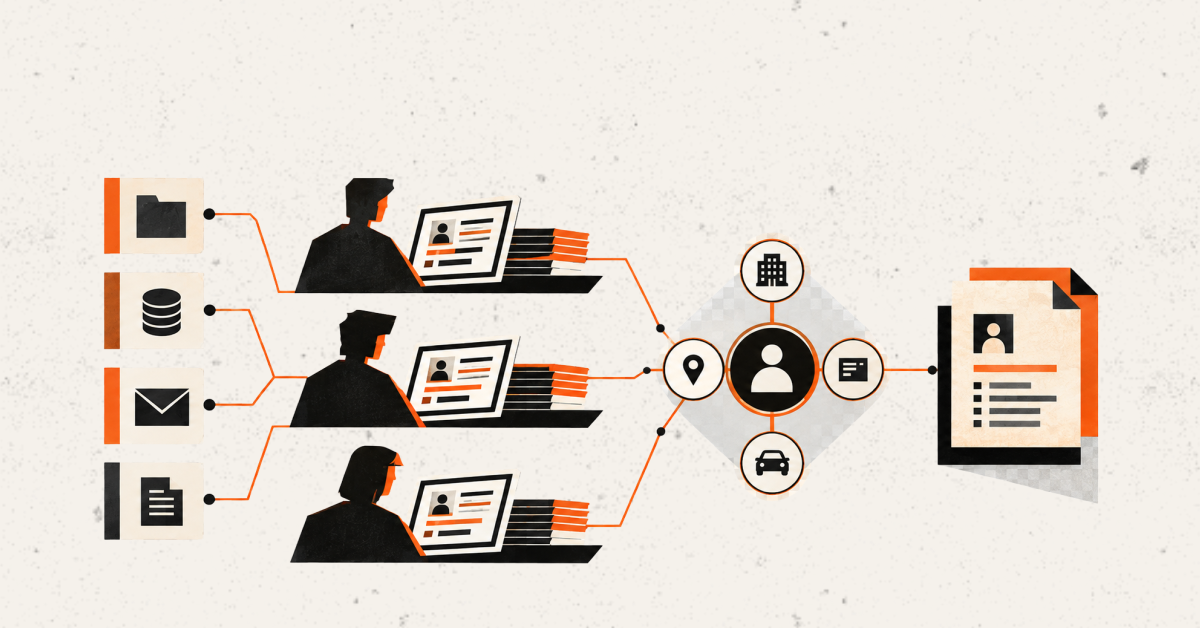
Consider a hypothetical example. A question comes in about a subject. An analyst pulls records from three systems, matches a name against a prior case, reconstructs a timeline, and reaches a view. Two weeks later a related question lands with a different analyst, who pulls the same records, rebuilds the same timeline, and uses a shared employee ID to confirm again that “J. Rivera” in one system and “Juan Rivera” in another are the same person. The first analyst’s report survived. The reasoning that produced it did not.
This can happen even when both analysts are diligent. A case management system may hold the final narrative, a records system the transactions, and an email thread the decision. Across those records, it can be difficult to trace how the investigator connected people, accounts, addresses, and events, or why a particular connection mattered.
A report can summarize a conclusion in full and still leave out the basis for an identity match. When a new question depends on that match, the next investigator may search the original systems and establish the link again.
What the research says about finding and checking information
In its 2012 study of social technologies, the McKinsey Global Institute estimated that the average interaction worker spends nearly 20 percent of the workweek looking for internal information or tracking down colleagues who can help with specific tasks.1 That estimate covers knowledge work broadly, not investigators specifically. The estimate captures time spent finding information, including a first search.
A cybersecurity survey looked specifically at the time teams spend checking potential threats. In a 2023 global survey of 1,000 security operations center team members, conducted by Morning Consult and commissioned by IBM, respondents reported spending on average about a third of their typical workday investigating and validating incidents that turned out not to be real threats. More than eight in ten said manual investigation of threats slows their overall response times.2 These self-reported figures cover incident validation. The survey did not ask how much of that work repeated an earlier investigation.
Forensic science researchers have raised a related concern. In a 2021 paper on forensic intelligence, Yaneisy Delgado and colleagues point to the lack of information sharing across agencies and jurisdictions and note that the same forensic data may contribute to solving additional cases.3 In other words, information developed in one investigation can have value beyond it, but only if it is kept in a form others can use.
If context is rebuilt every time, what is the point of a system that records the data?
This raises an awkward question for organizations that have invested heavily in case management. If the assembled context is not what the system preserves, then the system is mainly preserving the artifacts of past investigations in a form designed for retrieval and audit, not reuse. Auditability matters, so that is not worthless. But it means the organization may be paying repeatedly to recreate knowledge it already produced, and the cost is easy to miss because it is spread across many people, each rebuilding a little.
Rebuilding also carries a quality risk, not just a time cost. A picture reconstructed quickly under pressure can miss a connection that an earlier investigator had already found, simply because that earlier reasoning is not available to build on.
Preserving the model, not just the report
A higher standard treats the assembled context as something to keep. In practice that means three things. When records are matched to the same person or organization, that match is saved so the next investigator inherits it rather than redoing it. When an investigator draws a link between two entities, the link and the reason for it are recorded and searchable. And when a new question arrives, it can be asked against the accumulated picture, not only against raw records in separate systems.
For investigation teams that handle corporate incidents, misconduct, fraud, and security matters, Hubstream’s Investigative Case Management Solution is designed around this idea. It keeps people, entities, incidents, and the relationships between them connected across cases, so context accumulates instead of resetting when a case closes. The aim is not to replace investigator judgment. It is to spend less of that judgment on reconstruction.
Practical takeaway
Take one subject your team has investigated more than once in the past year. Trace what the second investigator had to redo: which records were pulled again, which identity matches were made again, and which links were rediscovered. That list can help you distinguish what was missing, what was hard to find, and what needed to be checked again.
Michael Chui et al., McKinsey Global Institute, “The Social Economy: Unlocking Value and Productivity Through Social Technologies,” July 2012. ↩︎
Morning Consult for IBM, “Global Security Operations Center Study Results,” March 2023, pp. 6–7. ↩︎
Yaneisy Delgado, Bradley S. Price, Paul J. Speaker, and Stephanie L. Stoiloff, “Forensic Intelligence: Data Analytics as the Bridge Between Forensic Science and Investigation,” Forensic Science International: Synergy 3, 100162, 2021. ↩︎